Sometimes a remortgage isn't the answer. A secured loan can be faster on adverse credit, cheaper for short-term needs, and easier when you're locked into a fix. We arrange both, and tell you straight which one fits.
A loan is a tool. The right tool depends on the job. Tell us what you're trying to do and we'll tell you which loan type fits, or whether a remortgage would suit better.
Borrow against the equity in your home, often without disturbing your existing mortgage.
Talk to an adviserRoll several debts into one manageable payment, often at a lower rate. Always advice-led, never automatic.
Talk to an adviserLoft, kitchen, extension, garden room. Borrow to add value to your home and pay back over the right term.
Talk to an adviserShort-term lending for chain breaks, auction purchases, refurbishments and probate. Same-day decision.
Talk to an adviserCCJs, defaults, recent IVAs, discharged bankruptcy. Placed with specialist secured loan lenders.
Talk to an adviserDirector's debenture, asset-backed business loans, and commercial bridging, for limited companies.
Talk to an adviserThe right answer for one client is the wrong answer for another. Here's how we think about it.
Debt consolidation can be a sensible move, or a costly mistake. Our job is to model both, openly, before you commit.
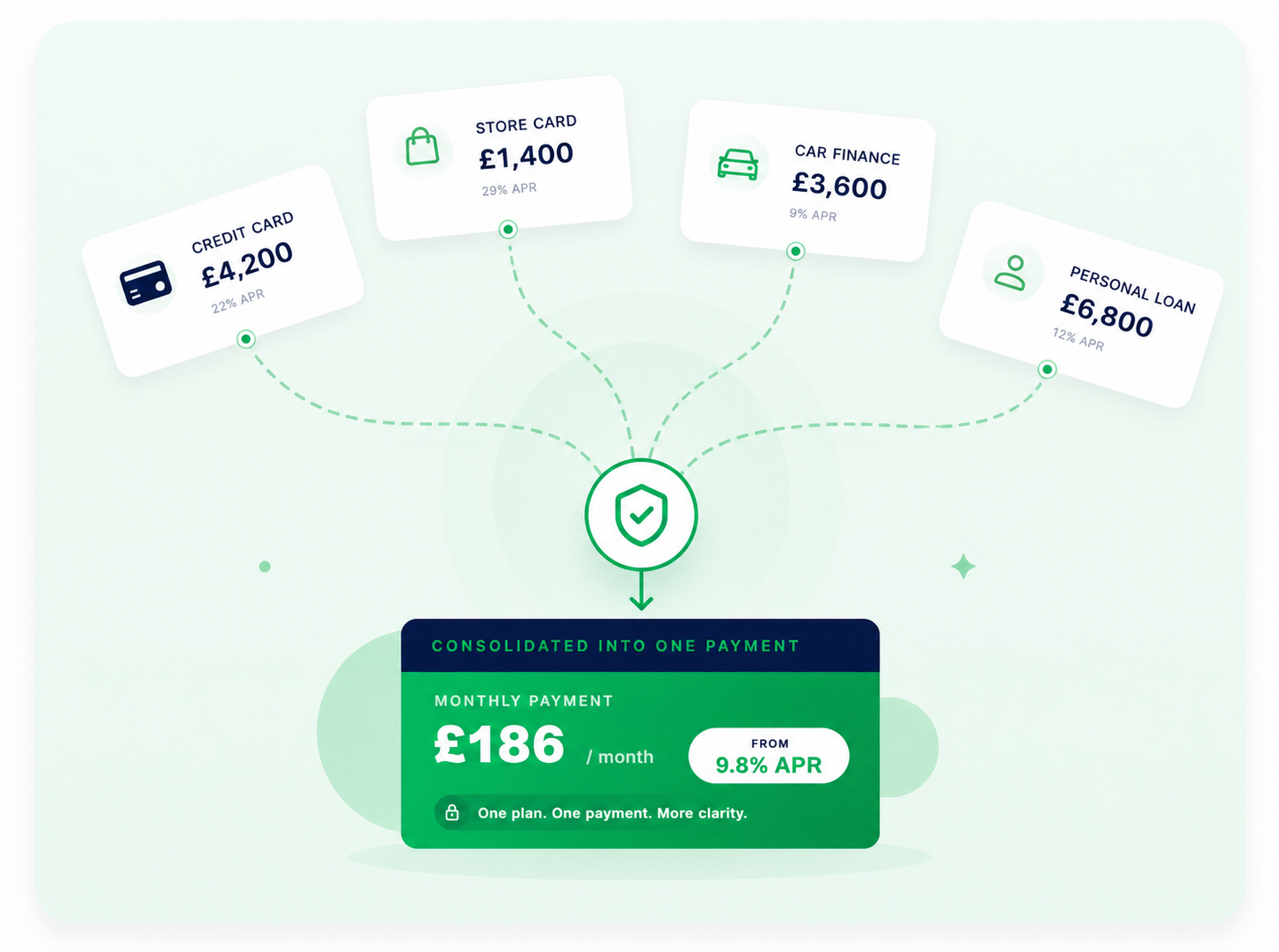
Rolling £15,000 of credit-card debt at 22% into a 25-year secured loan at 9% will reduce your monthly payment. But if you take the long term, you may pay more interest overall. Worse, you've moved unsecured debt onto your home.
We'll always model the same loan over a shorter term (e.g. 5 or 7 years) so you can see the trade-off in pounds and pence. We'll also flag situations where a debt management plan, a 0% balance transfer, or doing nothing is the better answer.
Both borrow money against your home. A remortgage replaces your existing mortgage with a bigger one. A secured loan is a second charge: a separate loan that sits behind your existing mortgage, leaving the original deal intact. Secured loans can be quicker, cheaper for smaller sums, and accept adverse credit more readily, but rates are typically higher than first-charge mortgages.
Yes. The secured loan market has a number of specialist lenders that manually underwrite cases involving CCJs, defaults, IVAs, and discharged bankruptcy. Rate and LTV will reflect the credit picture, but if there's affordability and equity, there's almost always a route. We'll tell you upfront, with rough numbers, on the first call.
Bridging finance can complete in 24–72 hours when needed (auction purchases, chain breaks). Standard secured loans typically complete in 2–4 weeks. Remortgages take 6–10 weeks. We'll match the product to your timescale on the first call.
Almost any legal purpose: home improvements, debt consolidation, business investment, school fees, vehicle purchase, deposits for additional property, tax bills, divorce settlements. Some lenders restrict purposes (e.g. tax bills require evidence); we'll tell you on the first call.
No, and we'll tell you so when it isn't. Rolling unsecured debt onto your home secures it against your property: there's a risk you didn't have before. We always model the same loan over a shorter term so you can see the true cost. For some clients a 0% balance transfer or DMP is a better answer.
Not until you instruct us to apply. Initial conversations and our first sourcing run use a soft search that doesn't affect your score. A hard search only happens with the lender we've agreed to apply to.
Tell us what you're trying to do. We'll tell you whether a loan, a remortgage, or something else suits best. No upfront cost, no obligation.